
Every sport has rules that fans hate.
But golf is different.
Golf has terrible rules that have existed for decades even though everyone agreed they were unjust. Rules that have ruined major championships (the four biggest tournaments of the year), ended Hall of Fame moments, and produced outcomes the rulebook itself looks at and shrugs.
What follows are the worst golf rules ever.
The ones that have caused real harm, real heartbreak, and in some cases real public outrage. Most are still on the books. A few were finally fixed — but only after decades of damage.
Buckle in.
1. The Lexi Thompson Incident And The Call-In Penalty
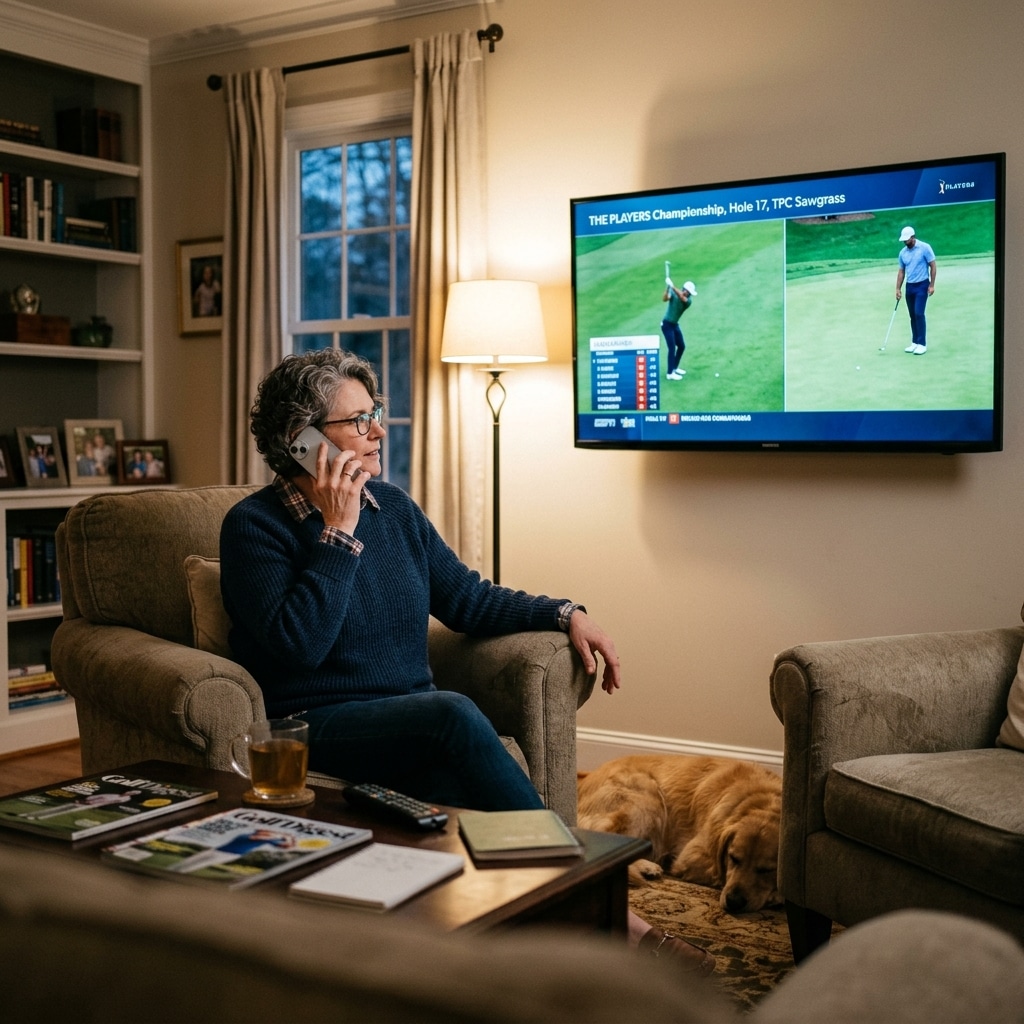
The 2017 ANA Inspiration — a women’s major championship — was effectively over.
Lexi Thompson held a two-shot lead through 12 holes of the final round. She’d shot 69-67-67 over the first three rounds, was playing brilliantly, and was on her way to her second major title.
Then LPGA rules official Sue Witters walked toward her on the way to the 13th tee.
“Is this a joke?”
That’s what Thompson asked when she heard the news.
It wasn’t a joke. A television viewer had emailed the LPGA that morning to report a possible rules violation.
Twenty-four hours earlier, on the 17th green during Saturday’s third round, Thompson had marked her ball with a coin — the standard practice of placing a coin behind the ball before lifting it, so you can return it to the exact same spot.
When she replaced the ball, she put it down approximately one inch from its original position. Officials reviewed the tape and concluded it was a real violation.
The penalty: two strokes for placing the ball in a wrong spot, plus two strokes for signing an incorrect scorecard the night before (since the original two-stroke penalty hadn’t been recorded).
Four shots, applied mid-round, in a tournament that was already essentially over.
Thompson, somehow, made three birdies in her last six holes to force a playoff. So Yeon Ryu won on the first extra hole.
Tiger Woods, who’d been a call-in victim himself at the 2013 Masters, tweeted:
“Viewers at home should not be officials wearing stripes.”
The “call-in viewer” loophole was closed shortly afterward. The LPGA changed its rules.
But the incident remains the clearest example of golf’s bizarre relationship with its own rulebook — that a one-inch ball placement, undetectable to the naked eye, reported by an anonymous viewer twenty-four hours after the fact, could decide a major championship.
An anonymous viewer with a TV remote and a grudge changed the outcome of a major.
2. The Scorecard Signature Disqualification

Roberto De Vicenzo. 1968 Masters (one of golf’s four majors, played at Augusta National). Final round, last group.
He made a birdie on the 17th hole — golf’s term for finishing a hole in one stroke under the expected score — from four feet. A beautiful putt that put him into a tie for the lead.
He made a bogey (one over expected) on 18, finishing what should have been a final-round 65. Tied with Bob Goalby.
The tournament was headed to an 18-hole playoff Monday to break the tie.
Except his playing partner Tommy Aaron, who was responsible for keeping De Vicenzo’s score on the scorecard, wrote down a 4 on the 17th hole instead of the 3 De Vicenzo actually made.
De Vicenzo, exhausted and emotional, signed the scorecard without checking carefully. By the time Aaron noticed his own error, the card had been turned in.
The rule was unforgiving: a score signed higher than actually shot must stand. De Vicenzo’s 65 became an official 66.
The playoff disappeared. Goalby won the green jacket — the iconic trophy awarded to the Masters winner.
“What a stupid I am,” De Vicenzo said. It became the most quoted sentence in golf history.
The rule was partially fixed in 2016 — unknown penalties now get added rather than triggering disqualification.
It was amended further in 2025, after Jordan Spieth was disqualified from the 2024 Genesis Invitational for the same kind of mistake. Spieth later admitted he was rushing because he needed to use the bathroom.
It only took 56 years.
A green jacket lost because somebody else wrote down the wrong number.
3. The Double-Hit Penalty

For decades, if your club accidentally contacted the ball twice during a single swing, you got a penalty stroke. Not because you tried. Not because you gained anything. Just because physics happened.
The most famous victim was T.C. Chen at the 1985 U.S. Open — one of golf’s four major championships. Leading by four shots in the final round, Chen attempted a chip shot (a short, low shot played near the green) from heavy rough.
His wedge — a short club designed for these recovery shots — made clean contact with the ball. But somehow, on the follow-through, the clubface clipped it a second time, almost imperceptibly.
Two-stroke penalty. Chen made an 8 on the hole — four shots worse than the expected score, which golfers call a quadruple-bogey.
His lead evaporated. He lost the tournament by one stroke. He was forever after known as “Two-Chip Chen.”
The rule was finally fixed in 2019, which now treats accidental double-hits as a single stroke with no penalty. Forty years too late for T.C. Chen.
A career-defining major lost because his clubface touched the ball for an extra millisecond.
4. The Fairway Divot Rule
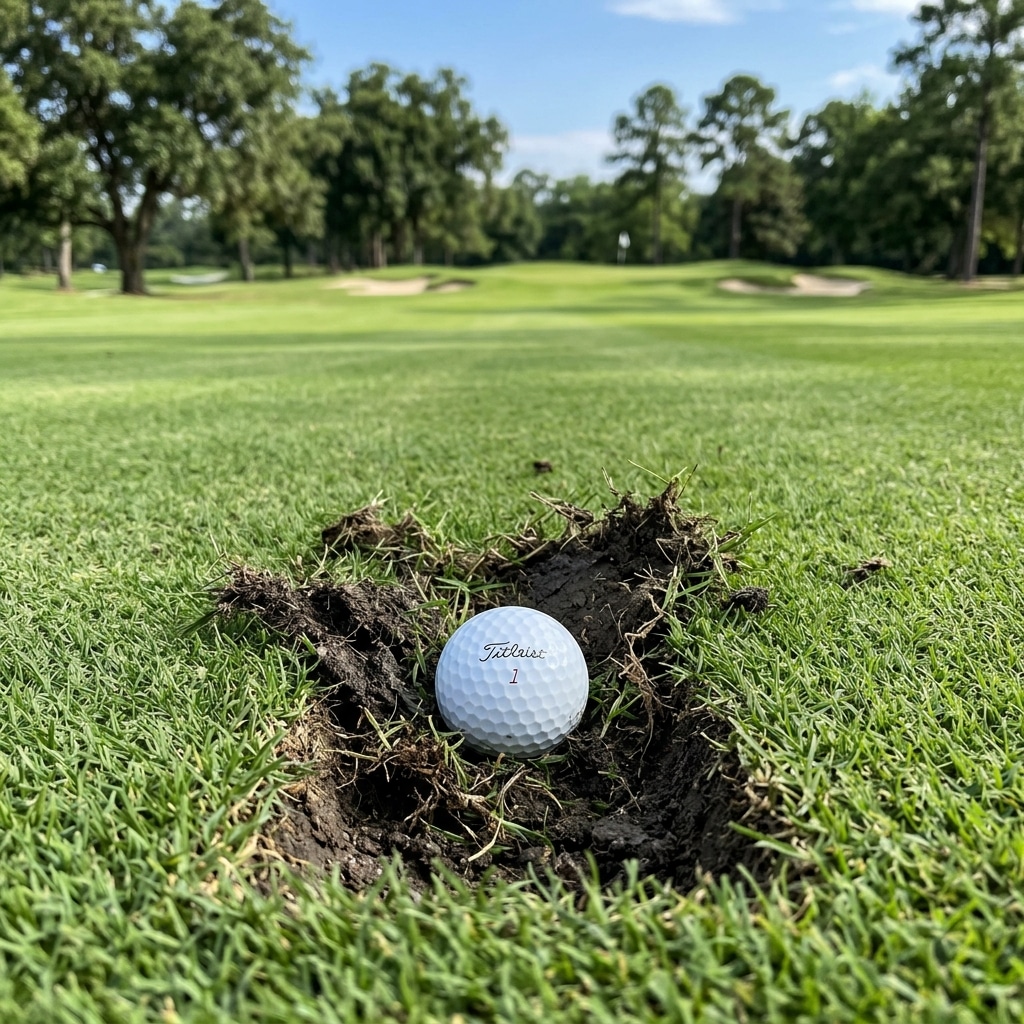
You hit the perfect drive. Down the middle, 280 yards, smack in the heart of the fairway — the mowed grass corridor you’re supposed to land on.
And your ball comes to rest at the bottom of someone else’s unrepaired divot — the scar another golfer carved out of the turf with an earlier swing.
Welcome to the most universally hated rule in golf.
There is no free relief for a ball that lands in a fairway divot. You play it as it lies.
Your reward for the best shot of your round is a half-buried ball, an awkward swing, and probably a shot that flies thirty yards short of the green.
The USGA has refused to fix this for decades, with the defense that defining “divot” is a definitional nightmare. So instead of solving the problem, the rulebook just shrugs.
It’s bad enough that I’ve never met a single golfer who defends this rule. Not one.
Hit the best shot of your life. Get punished for it.
5. Stroke-And-Distance For Out Of Bounds
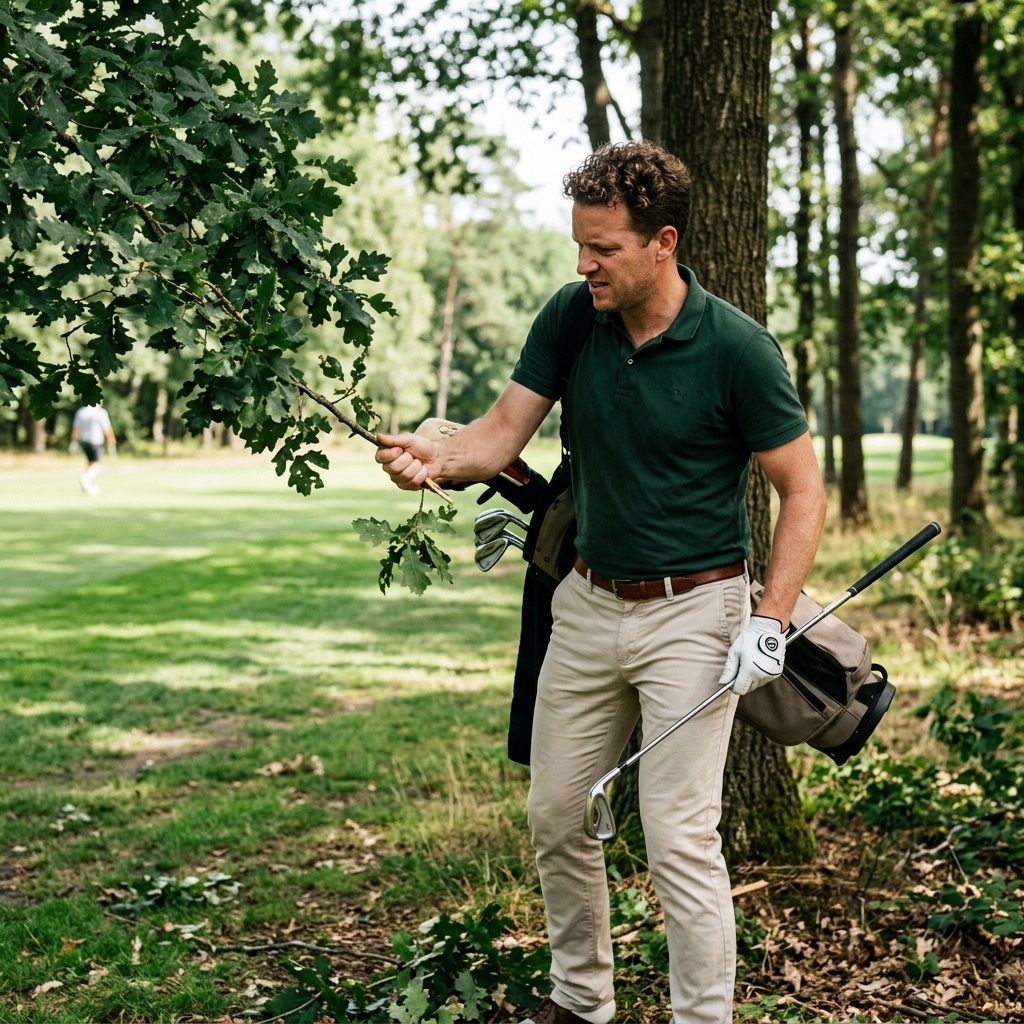
Hit one tee shot into the parking lot, and the penalty math gets brutal.
Here’s how it works.
When your ball goes out of bounds — meaning it crosses the line that defines the edge of the course — you have to do two things at once: take a penalty stroke AND go back to where you played your last shot.
That combination is called “stroke-and-distance,” because you lose both a stroke and the distance your ball traveled.
So the math: your original shot counts as one. The penalty counts as two. Your re-teed ball is your third stroke.
When you make solid contact with that new ball, you’re already at three before it even leaves the tee.
Hit another one out of bounds and you’re now on shot five — having played exactly two shots that actually went anywhere. This is how a single bad swing turns into an 8 before lunch, a score golfers grimly call a “snowman” because the number looks like one.
The rule’s brutal asymmetry is why the USGA finally created an alternative in 2019 — a two-stroke drop near where the ball went out, designed specifically to keep amateur rounds from turning into administrative disasters.
But in formal competition, the original stroke-and-distance rule still applies, full force.
One bad swing, and the math comes for your scorecard.
6. Asking What Club Someone Hit

This is a rule that criminalizes ordinary politeness.
A golfer hits a perfect approach shot to within four feet of the hole. You’re standing in the fairway behind them with a similar distance to the green. You ask, “What did you hit?”
Both of you just earned a two-stroke penalty in stroke play. Loss of hole in match play.
The rules treat club selection as competitive information. The official Definition of “Advice” specifically names club choice.
You can’t ask. They can’t tell. You can’t even touch another player’s bag to peek at their irons.
In what other sport does asking a polite question cost you strokes?
The justification is that strategic information is part of the game. But that argument falls apart when you remember caddies — the assistants who carry pro golfers’ bags — tell their players what to hit on every single shot.
The information itself isn’t sacred. Sharing it across players, apparently, is.
Be friendly. Lose two strokes.
7. The Lost Ball Clock

May 2026. The PGA Championship at Aronimink. Sahith Theegala stands in a fairway bunker on the par-4 10th hole, two shots off the lead.
He hits a perfectly reasonable approach shot. Television cameras follow the ball as it tracks toward the green. It clips a tree on the way down.
Nobody sees where it lands.
Theegala, his caddie, his playing partners, and the army of volunteers and spectators that follow every PGA Championship group spread out and search.
ESPN’s on-course reporter John McGuiness said simply: “We have no idea where it went.”
Three minutes is all you get.
When the clock runs out, the ball is officially lost — even if it would have been sitting in plain sight ten seconds later.
The rulebook does not care that you watched it land. It does not care that television tracked it. It does not care that twenty pairs of eyes were looking.
Theegala had to walk back to the bunker, replay the shot under stroke-and-distance, and make a triple-bogey 7 on a hole he had been playing in two shots.
The three-minute limit was actually shortened from five minutes in 2019 to speed up play — which improved pace at the cost of making the rule even crueler.
The rules of physics say the ball exists. The rules of golf say it doesn’t.
The ball is real. The clock decides otherwise.
8. The Provisional Ball Wording Trap

You stand on the tee, push your drive into the trees, and announce, “I’ll hit another one.”
Congratulations. You’ve just played your third shot.
Here’s the issue. Golf has a concept called a “provisional ball” — a backup shot you play just in case the first one is lost.
If you find the original, you pick up the provisional and play on with no extra penalty. If you don’t find it, the provisional becomes your ball in play.
The catch is that you have to specifically declare the second ball as a provisional.
If you don’t, that second ball isn’t a backup — it becomes your new ball in play under stroke-and-distance, meaning you’ve already taken the penalty whether you wanted to or not.
Even if your original ball is sitting in plain view ten yards into the fairway, you have to play the second one and eat the strokes.
The fix is the single word “provisional.” Use it, and the second ball is just a backup. Omit it, and you’ve sentenced yourself.
Forget to say one word. Forfeit two strokes.
9. The Wrong Ball Penalty

Two golfers playing the same brand and model of ball, with no distinguishing marks. Both balls land in the same patch of rough — the long, unkempt grass that borders the fairway. One golfer walks up, hits a beautiful shot, and immediately hears: “Wait, that’s mine.”
Result: Two-stroke penalty in stroke play. Loss of hole in match play.
The original shot doesn’t count. The error has to be corrected before the next tee.
The rulebook’s position is that ball identification is your responsibility, full stop.
Manufacturers selling millions of identical balls? Not the rulebook’s problem.
Common ball models that thousands of golfers play (Titleist Pro V1s alone make up a huge share of the market)? Not the rulebook’s problem.
Honest confusion in dim light at the edge of a forest? Definitely not the rulebook’s problem.
Mark your ball. Mark it weirdly. Mark it with three dots, your initials, and a tiny drawing of a snake.
Because the moment two unmarked balls share an area, somebody is getting penalized.
Identical balls. Honest mistake. Two strokes.
10. No Provisional For A Penalty Area

This one’s so counterintuitive it traps experienced golfers regularly.
If your ball might be lost in the woods, you can hit a provisional. If your ball might be in a penalty area — golf’s modern term for ponds, lakes, streams, and other marked hazards — you generally cannot.
Same uncertainty, same desire to keep pace of play moving, completely different rules treatment.
The justification under Rule 18.3a is that watching the result of a second shot might influence whether you’d want to attempt the original from inside the water.
So instead, you have to walk all the way to the pond, confirm the ball is in it, and walk all the way back to play a drop — adding minutes to every round.
This is a rule that hurts pace of play in the name of competitive integrity, when the real-world result is groups standing around watching one golfer take a hike to the lake.
*A rule designed to keep things fair, actively making everyone wait longer.*
—
11. The Boundary Stake Loophole
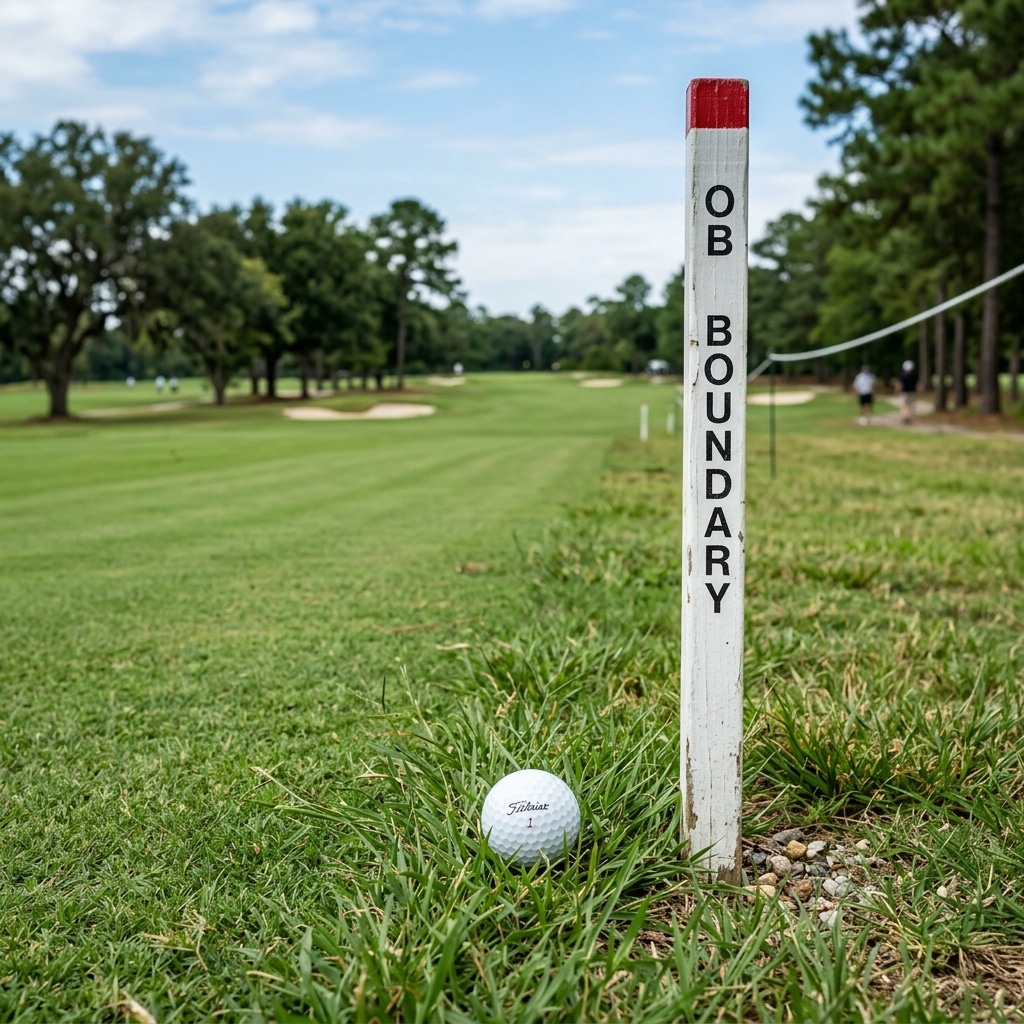
Most golf courses use small white stakes, pushed into the ground every twenty yards or so, to mark the boundary between in-bounds and out-of-bounds.
They look temporary. They feel temporary. Some of them are barely the size of a tent peg.
You cannot move them. Not even temporarily. Not even if one is sitting directly in your stance, ruining your swing path.
The official Definition of “Boundary Object” says these stakes are treated as immovable “even if they are movable or any part of them is movable.” Pull one out, bend it, or even nudge it, and you’ve earned a two-stroke penalty.
Meanwhile, a much larger and obviously artificial object — a cart path, a sprinkler head, a course bench — earns you free relief from interference.
The rulebook’s logic is that boundaries define the course and can’t be relocated. Fair enough. But applying that to a five-ounce plastic stake when a sixty-pound concrete cart path gives free relief is the kind of inconsistency that makes amateurs throw their hands up.
*A stake you could pull out with two fingers, treated like the Berlin Wall.*
—
12. The Ten-Second Hang Time Penalty

Your ball stops on the lip of the cup — the very edge of the hole, balanced right at the rim. You jog up to it, watching, hoping. Ten seconds pass. Eleven. Twelve.
It falls in.
Congratulations — the putt counts AND you get a penalty stroke.
Under Rule 13.3a, you get ten seconds to wait for gravity to finish the job.
Drop in during that window, you’re holed. Drop in after, you’re holed plus penalty.
The ball did the same thing in both cases. Physics doesn’t change just because a referee’s watch ticked past ten.
There is some logic here — without a limit, players could theoretically wait forever.
But a one-stroke penalty for a putt that actually went in feels wildly disproportionate. The ball is in the hole. The player did the work.
Charging a stroke for the privilege of letting gravity finish is the rulebook at its most petty.
*Make the putt. Pay a stroke anyway.*
—
13. Wind Moving Your Ball On The Green

You read the putt. You set your line. You take your stance. You begin your stroke.
And a gust of wind nudges your ball three feet to the left, into a place you now have to putt from.
Under Rule 9.3, natural forces moving a ball at rest carry no penalty — and no relief.
You play it from its new spot. The line you spent ninety seconds reading is now irrelevant. The putt you were about to make is gone.
This was on full display at the 2011 Open Championship, where multiple players had to watch their balls move on impossibly fast greens at Royal St. George’s.
The “play it as it lies” philosophy makes sense in theory. But the green is the one place where ball position has been carefully and deliberately established by the player.
Having that position erased by weather, with no recourse, feels closer to cruelty than fairness.
*Nature wins. You play from where nature put you.*
—
14. The Caddie Alignment Rule

January 2019. Final round of the Dubai Desert Classic. Haotong Li stands over a short birdie putt on the 18th green.
His caddie is just behind him, finishing some final notes on the line. Li takes his stance — the position of his feet just before swinging.
The caddie steps away. Li makes the putt.
Two-stroke penalty. Li drops from a tie for third to twelfth place. About $100,000 in prize money, gone.
The rule, Rule 10.2b(4), prohibits a caddie from standing directly behind a player — on what golfers call the “line of play,” the imaginary line extending from the ball toward the target — once the player begins setting up to hit.
The justification is that a caddie in that position could subtly help with aiming, even unintentionally.
Five days later at the Waste Management Phoenix Open, Denny McCarthy got hit with the same penalty under the same rule. The McCarthy penalty was later rescinded, but only after the outcry got loud enough.
European Tour CEO Keith Pelley called the ruling “grossly unfair.”
The USGA issued clarifications within weeks.
But the rule still exists, still produces penalties, and still catches players whose caddies weren’t doing anything except standing in a particular spot at the moment their player happened to begin taking a stance.
Your caddie’s job is to help you. The rule punishes both of you for it.
15. The Practice Swing Penalty

You take a relaxed practice swing six feet from your ball. Maybe to feel the lie (the position of the ball on the ground). Maybe to check your swing tempo.
Your club brushes through some long grass on the follow-through.
If that practice swing accidentally moves your ball — even by a millimeter — you’ve earned a one-stroke penalty, and you have to replace the ball.
The slow-motion replay era has made this rule worse, not better.
Microscopic ball movements that nobody could detect in real time get caught by high-definition broadcast cameras, and tour officials are essentially required to enforce them.
Players have been penalized for ball oscillation — wobbles so tiny the ball returned to its original spot before fully moving — because the rulebook used to make no distinction.
Some of this was relaxed in 2019, particularly on the putting green. But anywhere else, a practice swing that accidentally moves your ball is still a costly mistake.
A wobble that physics barely registers. The rulebook does.
16. The Hit-Another-Ball-On-The-Green Penalty

You’re putting from the back of the green. Another player’s ball is sitting fifteen feet in front of you, between your ball and the hole. You strike your putt — and on its way to the hole, it collides with that ball.
Two-stroke penalty.
This is the lone exception inside a rule that otherwise eliminated almost all “your ball hit a thing” penalties in 2019.
If both balls were on the green before your stroke, and your ball hits the other one, you get a two-stroke penalty in stroke play.
The justification is that you should have asked the other player to mark their ball — to place a coin behind it and pick it up so it wasn’t in your way.
The defense is that asking someone to mark a ball is a courtesy, not a rule. The player whose ball got hit didn’t have any obligation to mark it just because you needed to putt.
So the rulebook punishes the putter for circumstances both players helped create.
Match play, oddly, has no equivalent penalty. Same shot, same situation, same outcome — but in stroke play, two strokes; in match play, none.
A leftover penalty from an older rulebook nobody finished cleaning up.
17. The Anchored Putting Ban

Tim Clark has a rare medical condition.
He can’t supinate his forearms — meaning he physically cannot rotate his palms upward — which prevents him from tucking his elbows in during a putting stroke.
He has used a long putter, anchored against his body, since he was a teenager. It is the only way he can putt.
In 2010, Clark won the Players Championship — one of the most prestigious tournaments outside the four majors — using that anchored stroke.
In 2016, the USGA banned it.
The technique, called “anchored putting,” involves pressing the top of a long putter against the belly or chest, or pinning a hand against the forearm, to create a stable pivot point.
The theory is that anchoring removes the small twitches that ruin so many putts under pressure.
It worked, especially for older players and anyone with shaky hands.
Adam Scott won the 2013 Masters with one. Keegan Bradley won the 2011 PGA Championship — another of the four majors — with a “belly putter” pressed into his stomach. Webb Simpson and Ernie Els also won majors using the technique.
At a 2013 players’ meeting at Torrey Pines, Clark gave what was reportedly a dignified ten-minute speech against the proposed ban.
Multiple players credited his words with prompting PGA Tour commissioner Tim Finchem’s eventual opposition to the rule.
The Tour lost. The ban went through anyway.
“It’s our livelihood, not the USGA’s,” said tour pro Robert Garrigus, who didn’t even use a long putter.
The data never clearly showed anchored putting provided a meaningful competitive advantage.
But it was banned anyway, partly because the rulemakers decided anchoring removed a skill they thought should remain essential to the game.
For Tim Clark — and for thousands of recreational players with arthritis, back problems, or shaky hands — the rule didn’t just change a technique.
It took away the only way some of them could play.
A rule designed to preserve “skill” that disabled the players who needed help most.
18. The Nearest Point Of Relief Trap

Your ball comes to rest on a cart path — the paved track that golf carts use to get around the course.
Good news: you get free relief, meaning you’re allowed to pick up the ball and drop it nearby without penalty, because hitting off pavement could damage your club or your wrists.
Bad news: the rules require you to drop at the “nearest point of complete relief” — and that point might be in three inches of thick rough, two feet from a tree, with no realistic swing path to the green.
The rule forces a deterministic outcome. You don’t get to choose where to drop.
The nearest point is the nearest point, even when that point is dramatically worse than where you started.
Many golfers end up taking the relief, hitting a punch-out (a low, short recovery shot just to escape trouble), and wondering whether they would’ve been better off playing the original ball off the asphalt.
There’s a workaround — you can decline relief and play the ball as it lies — but the structural problem remains.
The rule routinely produces relief that’s worse than no relief, which is the opposite of what relief is supposed to do.
The rule grants you mercy. The mercy is worse than the problem.
19. The Stand-Behind-Your-Partner Rule

In partner formats — competitions where two players form a team — a player isn’t allowed to stand behind their partner while the partner is making a stroke.
Two confusing things about this.
First, “foursomes” and “four-ball” are golf-specific terms for two team formats — don’t confuse “foursome” with the casual word for a group of four players.
In foursomes, partners alternate shots playing one ball. In four-ball, each player plays their own ball and the team takes the better score.
Second, the rule sounds reasonable until you realize how it plays out.
You’re playing four-ball with your spouse, your work friend, your father. They’re about to hit.
You instinctively stand behind them to watch — the way every spectator at every golf event in history has watched their player.
That’s a two-stroke penalty. The rationale is that standing behind a partner could provide alignment help, even unintentionally. So the rule criminalizes watching your own partner play.
A rule that’s universally ignored because it’s universally considered ridiculous is, by definition, a bad rule.
A rule everyone breaks because nobody can take it seriously.

I’m Chris and I run this website – a resource about symbolism, metaphors, idioms, and a whole lot more! Thanks for dropping by.