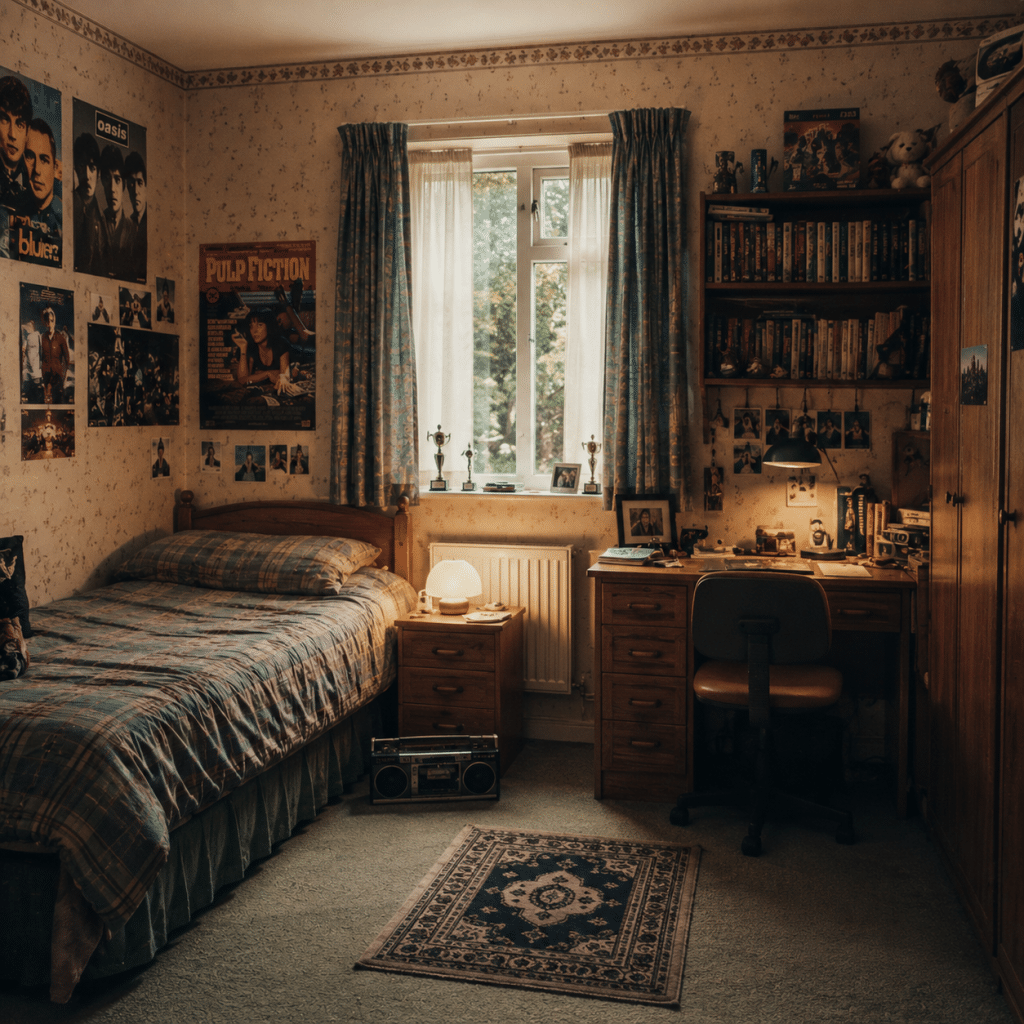
In the shifting landscape of a human life—defined by the constant churn of new addresses, hotel stays, and the transient “homes” of our adulthood—there usually exists one room that remains geographically fixed but emotionally fluid. It is the room you keep returning to. It may be a childhood bedroom, a study in a grandmother’s house, or a specific attic in an old apartment.
Regardless of its coordinates, this room functions as more than mere shelter. It is a chronometer of the self, a physical vessel that holds the ghosts of who you used to be while patiently waiting for the person you are becoming.
The Preservation of the Former Self
To enter this room is to experience a violent collapse of time. Unlike the rest of the world, which demands constant evolution and “updating,” the room you return to is often a museum of discarded identities.
- The Fossils of Taste: You find books on the shelves you no longer read, posters for bands you’ve forgotten, and the lingering scent of a specific dust or floor wax that triggers memories more effectively than any photograph.
- The Unchanged Light: There is a specific way the afternoon sun hits the carpet at 4:00 PM—a slant of light that has remained consistent while you were out in the world getting married, changing careers, or grieving losses.
In this room, you are not your resume or your current reputation. You are the sum of your developmental layers. It offers the rare, sometimes uncomfortable, opportunity to stand face-to-face with your younger selves.
The Weight of Familiarity
The “weight” of such a room lies in its profound lack of novelty. In a world that prizes the “new” and the “undiscovered,” there is a radical comfort in the predictable.
We return to this room because it requires nothing of us. In a new city or a sterile hotel, we must perform; we must navigate the space and establish a presence. But the room you keep returning to already knows your shape. It knows the specific creak of the floorboard near the door and the exact resistance of the window sash. It is a space where the “performance” of being an adult can be set aside at the threshold.
“A room we return to is a sanctuary where the friction of the world is smoothed over by the sheer repetition of our existence within its walls.”
The Mirror of Change
Ironically, we return to these static rooms to measure how much we have moved. The room stays the same so that we can see how we have grown.
When you sit in the same chair you sat in a decade ago, the chair hasn’t changed, but the way your body fits into it has. The problems you once paced the floor over now seem small, or perhaps they have been replaced by heavier ones. The room acts as a fixed point in a chaotic universe. By returning to it, we perform a sort of spiritual “re-calibration.” We check our current selves against the baseline of our origins.
Conclusion: The Return as Ritual
Ultimately, the room we keep returning to is a physical manifestation of the need for continuity. It reminds us that despite the many “versions” of ourselves we inhabit throughout a lifetime, there is a core that remains.
We return not to go backward in time, but to gather our strength. We step into that familiar light, breathe that familiar air, and for a brief moment, the disparate pieces of our lives—past, present, and future—sit quietly together in the same four walls. We return so that we can, eventually, leave again with a clearer sense of who is doing the leaving.

I’m Chris and I run this website – a resource about symbolism, metaphors, idioms, and a whole lot more! Thanks for dropping by.