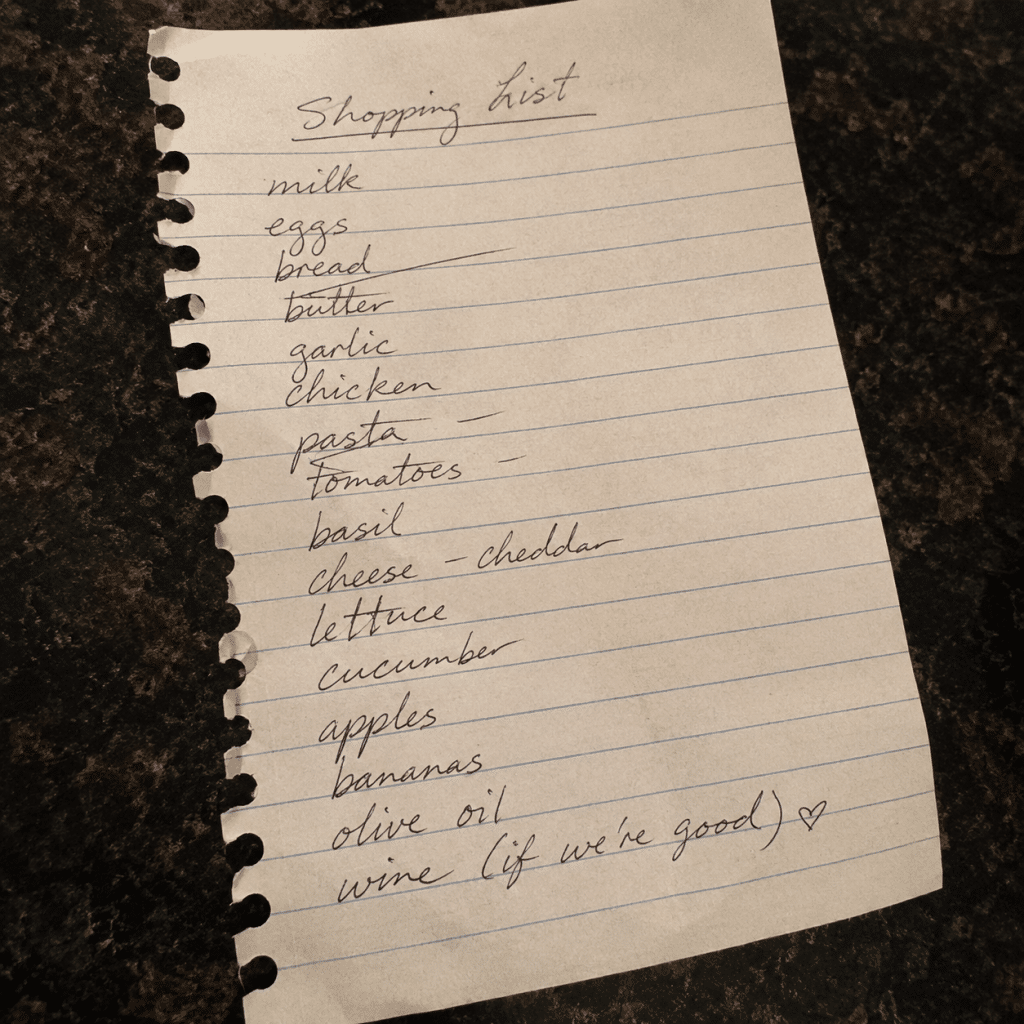
To the stranger, my mother’s handwriting is a messy thicket of ink—a series of hurried, leaning loops that look like a fence collapsing in a gale. But to me, it is a living map, a coded system of love, anxiety, and the quiet persistence of a woman who never had enough time. To read her script is to perform a kind of archaeological dig into the layers of her character.
The decoding of her hand is not about the letters themselves, but about the intent hidden in the pressure of the pen.
I. The Grocery List: The Script of Survival
The most common manifestation of her handwriting is found on the backs of envelopes and discarded receipts. These lists are written in a frantic, shorthand “urgent” style.
- The Descenders: The y in “bread” or the g in “eggs” doesn’t just curve; it stabs downward. This is the handwriting of a woman who is juggling three schedules, a failing radiator, and the weight of a household.
- The Omissions: She often leaves out vowels. “Milk” becomes Mlk. This isn’t laziness; it is a linguistic efficiency. She is writing at the speed of her own thoughts, and her hand is perpetually trying to catch up to a mind that is already three blocks away at the supermarket.
II. The Birthday Card: The Architecture of Performance
When the occasion demands it—a wedding, a graduation, a milestone—her handwriting undergoes a startling transformation. The “Fence in a Gale” becomes a “Cathedral.”
Here, the script is upright, the ink is dark, and the spacing is deliberate. There is a decorative flourish to the capital S and a proud, sweeping cross on every T. This is her aspirational hand. It is the handwriting she was taught by the nuns in the 1960s—a relic of a time when “penmanship” was a proxy for “character.” In these loops, I see her desire to present a version of herself that is composed, elegant, and in control. It is a costume made of ink.
III. The Marginalia of the Heart
The most revealing script, however, is found in the margins of her cookbooks or the notes left on the kitchen counter. This is her “resting hand,” and it is where the real decoding happens.
- The Slant of Mood: When she is tired, her writing loses its verticality and begins to lay flat, as if the words themselves are exhausted and need to lie down.
- The “Love” Signature: The way she writes her own name at the end of a note is a barometer of our relationship. If the M in Mom is large and rounded, we are in a season of peace. If it is sharp and jagged, I know I have overstayed my welcome or forgotten a phone call.
“Her handwriting is a seismograph of her soul, recording the tremors of her day-to-day life with a precision she would never admit to in speech.”
IV. The Ink of Memory
As she ages, the script is changing again. There is a slight tremor in the long strokes, a “ghosting” of the ink where her hand hesitated before committing to the paper.
Decoding this new development is the hardest task of all. It is the script of vulnerability. The handwriting that once commanded the household is now becoming lighter, more ephemeral. It is as if the words are preparing to evaporate.
Conclusion: The Unspoken Biography
We spend our lives listening to our mothers’ voices, but we should spend more time studying their hands. A voice can be modulated, a face can be masked, but the way a person carves their thoughts into a page is an act of involuntary honesty.
My mother’s handwriting is a messy, beautiful, contradictory biography. It tells the story of a woman who was rushed, who was proud, who was tired, and who was always, fundamentally, there. Even when she is gone, I will be able to run my fingers over the indentations she left in the paper and know exactly what she was feeling the moment the pen hit the page. I don’t need a Rosetta Stone; I just need to look at the ink.

I’m Chris and I run this website – a resource about symbolism, metaphors, idioms, and a whole lot more! Thanks for dropping by.